Latest Updates

Saturday, June 1, 2024

Questmist.com: An Online Dream Journal and Community - Share Your Dreams, Get Paid


Questmist.com_Dream_Journal


Questmist.com: An Online Dream Journal and Community - Share Your Dreams, Get Paid

Introduction

In today's digital age, dreams are no longer confined to the subconscious; they can now be recorded, shared, and monetized. Questmist.com offers a unique platform where users can maintain an online dream journal, share their dreams with a community, and even get paid. This article delves into the myriad aspects of Questmist.com, exploring its features, benefits, and how it stands out in the digital landscape.

What is Questmist.com?

Questmist.com is an innovative online platform designed for dream enthusiasts. It allows users to document their dreams in a personal journal, share them with a vibrant community, and earn money through various engagement methods. Whether you're a casual dreamer or someone who deeply analyzes their dreams, Questmist.com offers a space to explore and monetize your nocturnal narratives.

The Importance of Dream Journaling

Dream journaling is not just a pastime; it’s a powerful tool for self-discovery and mental health. Keeping a dream journal can help individuals:

- Gain insights into their subconscious mind

- Identify recurring themes or patterns

- Improve memory and recall skills

- Foster creativity and problem-solving abilities


Questmist.com enhances these benefits by providing a structured and interactive platform for dream journaling.

Key Features of Questmist.com

 User-Friendly Interface

Questmist.com boasts a user-friendly interface that makes it easy to document and navigate your dreams. The intuitive design ensures that even beginners can start their dream journal without any hassle.

Privacy and Sharing Options

Users can choose to keep their dreams private or share them with the community. This flexibility ensures that you can control your dream journal's privacy settings according to your comfort level.

Community Engagement

The platform fosters a strong sense of community by allowing users to comment on and discuss shared dreams. This interaction can lead to deeper interpretations and a richer understanding of one's dreams.

Earning Opportunities

One of the standout features of Questmist.com is the ability to earn money by sharing your dreams. Through a variety of engagement options, such as likes, comments, and shares, users can monetize their dream content.

Advanced Dream Analysis Tools

Questmist.com provides tools to help users analyze their dreams more effectively. These tools can include keyword tagging, thematic categorization, and even AI-generated insights based on dream content.

How to Get Started on Questmist.com

Creating an Account

Getting started on Questmist.com is straightforward. Users can sign up using their email or social media accounts. The registration process is quick, ensuring that you can start journaling your dreams without delay.

Setting Up Your Dream Journal

Once registered, users can set up their dream journal by customizing their profile, choosing privacy settings, and starting their first dream entry. The platform provides prompts and tips to help you accurately record your dreams.

Sharing and Earning

Users can share their dreams with the community by selecting the public option when making an entry. The more engagement your dreams receive, the higher the earning potential. Questmist.com offers various payout methods, ensuring that you can easily access your earnings.

The Science Behind Dream Journaling

Dreams have fascinated humans for centuries, and modern science continues to explore their significance. Dream journaling, supported by platforms like Questmist.com, can:

- Enhance cognitive functions such as memory and creativity

- Provide psychological insights that can aid in mental health treatments

- Serve as a therapeutic tool for processing emotions and experiences


Benefits of Using Questmist.com

For Individuals

- **Self-Discovery**: Gain deeper insights into your subconscious mind.

- **Community Support**: Engage with a community that shares your interest in dreams.

- **Monetary Gain**: Earn money for sharing your dream experiences.

For Researchers

- **Data Collection**: Access a vast database of dream journals for research purposes.

- **Pattern Analysis**: Utilize advanced tools to analyze common themes and patterns in dreams.


For Creatives

- **Inspiration**: Use dreams as a source of inspiration for artistic and creative projects.

- **Collaboration**: Connect with other creatives who draw inspiration from their dreams.


Community and User Stories


Real-Life Impact

Numerous users have shared how Questmist.com has impacted their lives. For some, it’s a therapeutic outlet, while for others, it’s a source of inspiration for their creative projects. 


Case Studies

Case studies of users who have successfully monetized their dream journals can provide motivation and practical insights for new users.


Expert Insights


Psychological Perspectives

Psychologists and dream analysts provide insights into the importance of dream journaling and how platforms like Questmist.com can aid in self-discovery and mental health.


Technology and Dream Analysis

Experts discuss how modern technology, integrated into platforms like Questmist.com, enhances the traditional practice of dream journaling with advanced analysis tools.


Conclusion

Questmist.com is revolutionizing the way we perceive and interact with our dreams. By offering a platform that combines dream journaling, community engagement, and monetization, it caters to a wide range of users, from casual dreamers to serious researchers. Whether you're looking to explore your subconscious or earn money by sharing your dreams, Questmist.com provides the tools and community support you need.


dream sharing platform, share dreams online, dream journal, dream sharing, dream community, dream exploration, dream discussion, dream experiences, dream sharing platform, online dream journal, dream journaling, dream analysis, dream interpretation, lucid dreaming, subconscious exploration, dream forum, dream conversations, dream community platform, dream sharing website, dream enthusiasts, dream diary, dream storytelling.dream sharing, dream analysis, dream logging, dream journals, lucid dreaming, dream interpretation, compare dreams, add dreams, dream share, lucid dreams, how to have a lucid dream, how to get lucid, dream dictionary, share my dreams, crazy dreams, sexual dreams, precognative dreams, mystical dreams, dream symbols, dream forum, dream discussion, sleep disorders, sleep paralysis, OBE, out of body experience, out of body experiences, astral travel, astral projecting, astral projection, how to have a lucid dream, lucid dreams
Read more ...

Monday, October 19, 2020

Merging and sorting files on Linux

 three global network puzzle pieces


There are a number of ways to merge and sort text files on Linux, but how to go about it depends on what you're trying to accomplish – whether you simply want to put the content of multiple files into one big file, or organize it in some way that makes it easier to use. In this post, we'll look at some commands for sorting and merging file contents and focus on how the results differ.

Using cat

If all you want to do is pull a group of files together into a single file, the cat command is an easy choice. All you have to do is type "cat" and then list the files on the command line in the order in which you want them included in the merged file. Redirect the output of the command to the file you want to create. If a file with the specified name already exists, it will be overwritten by the one you are creating. For example:

$ cat firstfile secondfile thirdfile > newfile
$ cat firstfile secondfile thirdfile >> updated_file

If the files you are merging follow some convenient naming convention, the task can be even simpler. You won't have to include all of the file names if you can specify them using a regular expression. For example, if the files all end with the word "file" as in the example above, you could do something like this:

$ cat *file > allfiles

Note that the command shown above will add file contents in alphanumeric order. On Linux, a file named "filea" would be added before one named "fileA", but after one named "file7". After all, we don't just have to think "ABCDE" when we're dealing with an alphanumeric sequence; we have to think "0123456789aAbBcCdDeE". You can always use a command like "ls *file" to view the order in which the files will be added before merging the files.

NOTE: It's a good idea to first make sure that your command includes all of the files that you want in the merged file and no others – especially when you're using a wild card like “*”. And don't forget that the merged files will still exist as separate files, which you might want to delete once the merge has been verified.

Merging files by age

If you want to merge your files based on the age of each file rather than by file names, use a command like this one:

$ for file in `ls -tr myfile.*`; do  cat $file >> BigFile.$$; done

Using the -tr options (t=time, r=reverse) will result in a list of files in oldest-first age order. This can be useful, for example, if you're keeping a log of certain activities and want the content added in the order in which the activities were performed.

The $$ in the command above represents the process ID for the command when you run it. It's completely unnecessary to use this, but it makes it nearly impossible that you will inadvertently add onto the end of an existing file instead of creating a new one. If you use $$, the resultant file might look like this:

$ ls -l BigFile.*
-rw-rw-r-- 1 justme justme   931725 Aug  6 12:36 BigFile.582914

Merging and sorting files

Linux provides some interesting ways to sort file content before or after the merge.

Sorting content alphabetically

If you want the merged file content to be sorted, you can sort the overall content with a command like this:

$ cat myfile.1 myfile.2 myfile.3 | sort > newfile

If you want to keep the content grouped by file, sort each file before adding it to the new file with a command like this:

$ for file in `ls myfile.?`; do sort $file >> newfile; done

Sorting files numerically

To sort file contents numerically, use the -n option with sort. This option is useful only if the lines in your files start with numbers. Keep in mind that, in the default order, “02” would be considered smaller than "1". Use the -n option when you want to ensure that lines are sorted in numeric order.

$ cat myfile.1 myfile.2 myfile.3 | sort -n > xyz

The -n option also allows you to sort file contents by date if the lines in the files start with dates in a format like "2020-11-03" or "2020/11/03" (year, month, day format). Sorting by dates in other formats will be tricky and will require far more complex commands.

Using paste

The paste command allows you to join the contents of files on a line-by-line basis. When you use this command, the first line of the merged file will contain the first line of each of the files being merged. Here's an example in which I've used capital letters to make it easy to see where the lines came from:

$ cat file.a
A one
A two
A three

$ paste file.a file.b file.c
A one   B one   C one
A two   B two   C two
A three B three C thee
        B four  C four
                C five

Redirect the output to another file to  save it:

$ paste file.a file.b file.c > merged_content

Alternately, you can paste files together such that the content of each file is joined in a single line. This requires use of the -s (sequential) option. Notice how the output this time shows each file's content:

$ paste -s file.a file.b file.c
A one   A two   A three
B one   B two   B three B four
C one   C two   C thee  C four  C five

Using join

Another command for merging files is join. The join command allows you to merge the content of multiple files based on a common field. For example, you might have one file that contains phone numbers for a group of coworkers and another that contains their personal email addresses and they’re both listed by the individuals' names. You can use join to create a file with both phone numbers and email addresses.

One important restriction is that the files must have their lines listed in the same order and include the join field in each file.

Here's an example command:

$ join phone_numbers email_addresses
Sandra 555-456-1234 bugfarm@gmail.com
Pedro 555-540-5405
John 555-333-1234 john_doe@gmail.com
Nemo 555-123-4567 cutie@fish.com
Read more ...

How to download and play YouTube and other videos on Linux

 A user video conferences via tablet. [teleconference / online meeting / digital event]


Who would have imagined that there’s a Linux tool available for downloading YouTube videos? Well, there is and it works for Linux as well as for other operating systems. So, if you need to watch some of the available videos even when your internet connection is flaky or you need to be offline for a while, this tool can be especially handy.

The tool for downloading videos is called youtube-dl. (The “dl” portion undoubtedly means “download”.) It’s very easy to use and drops webm or mp4 files onto your system. Both formats provide compressed, high-quality video files that you can watch whenever you like.

The youtube-dl tool is a Python-based command-line tool. On Linux, it requires Python (2.6, 2.7, or 3.2+). The command to install it on Ubuntu and related systems is:


$ sudo apt-get install youtube-dl

Once installed, you can use a command like this to download a video after selecting the URL from YouTube or some other source:

$ youtube-dl <video URL>

Here is an example that can serve as a quick test:

$ youtube-dl https://www.youtube.com/watch?v=C0DPdy98e4c

After you successfully run the test you can try downloading a video of your own choosing. Depending on the size of the file, the download might take a couple of minutes or longer. If you watch the screen, you’ll see updates on the expected time remaining.

Once a video is downloaded, you can play it by double-clicking on the icon in your file manager or you can kick it off on the command line using totem. Totem is a GNOME desktop movie player based on GStreamer and likely already on your system.

$ which totem
/usr/bin/totem
$ totem 'Gather the Spirit music & lyrics-CWnrwetbrbc.webm'

Note that youtube-dl works not just for youtube videos, but videos from many sources. A very short Crazy Frog mp4 video could be downloaded with a command like this one. Notice that this short download only took eight seconds.

$ youtube-dl https://www.dailymotion.com/video/x3b4gfs
[dailymotion] Downloading Access Token
[dailymotion] x3b4gfs: Downloading media JSON metadata
[dailymotion] x3b4gfs: Downloading metadata JSON
[dailymotion] x3b4gfs: Downloading m3u8 information
[download] Destination: Crazy Frog The Original Crazy Frog Song HD Quality!-x3b4gfs.mp4
[download] 100% of 9.74MiB in 00:08
$ ls -l Crazy*
-rw-rw-r-- 1 shs shs 10216863 Jan 25  2019 'Crazy Frog The Original Crazy Frog Song HD Quality!-x3b4gfs.mp4'

While downloaded videos can prove very useful, you should probably be wary of potential legal issues should you go beyond the most modest use of them. You must be careful to avoid copying, reproducing, distributing, transmitting, broadcasting, displaying, selling, licensing, or otherwise exploiting any content without the prior written consent of the owner(s). These constraints are fairly typical, though some videos may not involve copyrights or legal restrictions.

Read more ...

The OSI model explained and how to easily remember its 7 layers


When most non-technical people hear the term “seven layers”, they either think of the popular Super Bowl bean dip or they mistakenly think about the seven layers of Hell, courtesy of Dante’s Inferno (there are nine). For IT professionals, the seven layers refer to the Open Systems Interconnection (OSI) model, a conceptual framework that describes the functions of a networking or telecommunication system.

The model uses layers to help give a visual description of what is going on with a particular networking system. This can help network managers narrow down problems (Is it a physical issue or something with the application?), as well as computer programmers (when developing an application, which other layers does it need to work with?). Tech vendors selling new products will often refer to the OSI model to help customers understand which layer their products work with or whether it works “across the stack”.

Conceived in the 1970s when computer networking was taking off, two separate models were merged in 1983 and published in 1984 to create the OSI model that most people are familiar with today. Most descriptions of the OSI model go from top to bottom, with the numbers going from Layer 7 down to Layers.

Layer 7 - Application

To further our bean dip analogy, the Application Layer is the one at the top--it’s what most users see. In the OSI model, this is the layer that is the “closest to the end user”. It receives information directly from users and displays incoming data it to the user. Oddly enough, applications themselves do not reside at the application layer. Instead the layer facilitates communication through lower layers in order to establish connections with applications at the other end. Web browsers (Google Chrome, Firefox, Safari, etc.) TelNet, and FTP, are examples of communications  that rely  on Layer 7.

Layer 6 - Presentation

The Presentation Layer represents the area that is independent of data representation at the application layer. In general, it represents the preparation or translation of application format to network format, or from network formatting to application format. In other words, the layer “presents” data for the application or the network. A good example of this is encryption and decryption of data for secure transmission - this happens at Layer 6.

Layer 5 - Session

When two devices, computers or servers need to “speak” with one another, a session needs to be created, and this is done at the Session LayerFunctions at this layer involve setup, coordination (how long should a system wait for a response, for example) and termination between the applications at each end of the session.

Layer 4 – Transport

The Transport Layer deals with the coordination of the data transfer between end systems and hosts. How much data to send, at what rate, where it goes, etc. The best known example of the Transport Layer is the Transmission Control Protocol (TCP), which is built on top of the Internet Protocol (IP), commonly known as TCP/IP. TCP and UDP port numbers work at Layer 4, while IP addresses work at Layer 3, the Network Layer.

Layer 3 - Network

Here at the Network Layer is where you’ll find most of the router functionality that most networking professionals care about and love. In its most basic sense, this layer is responsible for packet forwarding, including routing through different routers. You might know that your Boston computer wants to connect to a server in California, but there are millions of different paths to take. Routers at this layer help do this efficiently.

Layer 2 – Data Link

The Data Link Layer provides node-to-node data transfer (between two directly connected nodes), and also handles error correction from the physical layer. Two sublayers exist here as well - the Media Access Control (MAC) layer and the Logical Link Control (LLC) layer. In the networking world, most switches operate at Layer 2. But it's not th at simple. Some switches also operate at Layer 3 in order to support virtual LANs that may span more than one switch subnet, which requires routing capabilities.

Layer 1 - Physical

At the bottom of our OSI bean dip we have the Physical Layer, which represents the electrical and physical representation of the system. This can include everything from the cable type, radio frequency link (as in an 802.11 wireless systems), as well as the layout of pins, voltages and other physical requirements. When a networking problem occurs, many networking pros go right to the physical layer to check that all of the cables are properly connected and that the power plug hasn’t been pulled from the router, switch or computer, for example.


Read more ...

Backing up databases is critical and complex


Database models

There are at least 13 different database models, and knowing how to back up yours starts with knowing what kind of database you are backing up.

These models include: relational (the most common), key-value, time series, document, graph, search engine, wide column, object oriented, RDF, multivalue, native XML, navigational, and event. The following is a list of just the most popular models, along with a few whose popular databases have generated a lot of backup questions.

Relational

A relational database management system (RDBMS) is what most people think of when they say the word database: a series of tables with a defined schema (table layout), records (rows), and attributes (values).  Examples include Oracle, SQL Server, MySQL, and PostgreSQL.  These databases are often called SQL databases, after the query language they use.

Key-value

A very simple NoSQL (Not only SQL) DBMS, consisting of keys and values, where you can look up the value if you know the key. Popular examples are Redis and DynamoDB.

Time series

A NoSQL database specifically designed to handle time data, as each entry has a time stamp.  The popular Prometheus database is an example and is used quite a bit in Kubernetes.

Document

A schema-free NoSQL DBMS is designed specifically to store documents. Records do not need to conform to any uniform standard and can store very different types of data. JSON is often used to store documents in such a database. MongoDB is the most popular database that supports only the document model.

Wide column

Another schema-free NoSQL DBMS that can store very large numbers of columns of data without a predefined schema is the wide-column model. Column names and keys can be defined throughout the database. Cassandra is the best known database of this type.

Database terminology

Database terminology is also important, so what follows is a list of important terms. Not all databases use the same terms, but they should have a similar term that means the same thing. NoSQL databases often use very different terms or may lack something similar to the item in question.

Datafile: A datafile is where a database stores its data. This may be a raw device (e.g., /dev/hda1 in Linux), or a “cooked” file (e.g., /sap/datafiles/dbs06.dbf or c:\MySQL\datafile.dbf). At this point, most databases use cooked or regular files as datafiles, and most have more than one for each database.

Table: This is where things get a bit murky.  In a SQL, relational, database, a table is a bunch of related values that behaves kind of like a virtual spreadsheet. NoSQL databases may have something similar or they may not.

Tablespace: A tablespace is a space where you put tables and is a collection of one or more datafiles. If your database doesn’t have tables, it probably doesn’t have tablespaces.

Partition: Modern databases can divvy up and spread or partition a table across multiple resources, including multiple tablespaces.

Sharding: Sharding takes partitioning to another level and is the key to large scale-out databases. Sharding can even place pieces—shards—of a table on different nodes.

Master database: A master database keeps track of the status of all databases and datafiles. If multiple databases are allowed, it needs to keep track of them as well.

Transaction: A transaction is an activity within a database that changes one or more attributes within one or more tables. Simple transactions change one attribute, and complex transactions will change many attributes as a single, atomic actionNoSQL databases tend to use simple transactions, and many who use them don’t even think of their transactions as such.

Transaction log: A transaction log records each transaction and what elements it changed. This information is used in case of a system crash or after a restore to either undo or redo transactions.

Consistency models

There are two very different ways databases ensure that views of inserted or updated database data are the same for all viewers of the database. These are referred to as consistency models, and they affect backup and recovery.

The first is immediate consistency, also known as strong consistency, and it ensures that all users will see the same data at the same time, regardless of where or how they view the data. Most traditional, relational, databases follow this model.

The second model is an eventually consistent or weak-consistency database, whiich  ensures that a given attribute will eventually be consistent for all viewers, but that may take some time. A great example of eventual consistency is within the DNS system, which has to wait until the time-to-live for DNS records has expired before updating information about domain names. This can take up to 72 hours.

What, how, and why are you backing up?

If you’re responsible for backing up a database, you need to understand how it is built and how it works. You need to understand where it stores its data, such as datafiles, whether or not it uses complex or simple transactions, and where it stores the log of those transactions. You will need to know how to get a consistent backup of the stored data and the transaction log.

You also need to understand how distributed your database is. Is it partitioned, but all within one host or is it sharded and spread across dozens or hundreds of hosts?  If it is the latter, you will most likely be dealing with an eventually consistent database. Getting a consistent snapshot of a database spread across hundreds of nodes will be quite challenging, and restoring it will be just as challenging.

Some may think that an eventually consistent database that uses replication across many nodes doesn’t need to be backed up, but it definitely does. While you are protected against node failure, you are definitely not protected against human error. If you drop a table, it doesn’t matter how replicated it is. You will need to restore it.


Read more ...

Wi-Fi vs 5G


Wi-Fi’s reliability is challenged foremost by its range, Filkins says. “You may be able to guarantee, or not, a service-level, but almost certainly only guarantee it over a short-to-medium range,” he says. Also, most Wi-Fi systems are deployed across unlicensed bands, he says, and the potential for interference becomes greater as more packets share channels.


Wi-Fi 6 helps with the reliability issue by splicing spectrum into resources units, Filkins says, but even with these improvements there’s still the spectrum problem itself, “which introduces potential for interference.”


Deployment costs, range, interference, and the capabilities of IoT devices are all factors in identifying the right primary or complementary connectivity option for an IoT implementation, Menezes says.


“Base the decision on the implementation’s network-performance requirements,” Menezes says. “So, if an endpoint or application doesn’t need 5G performance to function at the required level, that will help dictate the connectivity choice.”


Wi-Fi 6 or Zigbee might be perfectly suitable for some elements of a smart-building controls, but useless for a highly mobile wide area use, Menezes says.


“Further, endpoints using essentially commoditized connectivity technologies such as Bluetooth, Zigbee, RFID, or Wi-Fi may be significantly more cost effective in scenarios where 5G may be available but has not yet reached significant marketplace scale to make endpoints or network services competitive,” Menezes says.


In some cases, such as home use, Wi-Fi usually makes more sense for IoT than cellular, says Shree Dandekar, vice president, Global Product Organization, at consumer goods manufacturer Whirlpool, which offers IoT services such as connected kitchen and laundry appliances.


“The tech world is pretty much aligned to this view, and it is unlikely that 5G technology changes this,” Dandekar says. “Even the cheapest cellular technology [NB-IoT or LTE-M] is significantly more expensive than Wi-Fi.”


On the other hand, Whirlpool’s factories are a different situation altogether. “That environment can be a challenge for Wi-Fi because of so much equipment and so many machines; it’s just a lot of metal that can impact a Wi-Fi signal,” says Michael Berendsen, vice president of IT.


The company is testing 5G on some of its autonomous vehicles at a washing machine plant in Ohio, “because we believe 5G could provide better coverage and be more consistent across such a large space,” Berendsen says.

Read more ...

What is Nmap? Why you need this network mapper


What is Nmap?

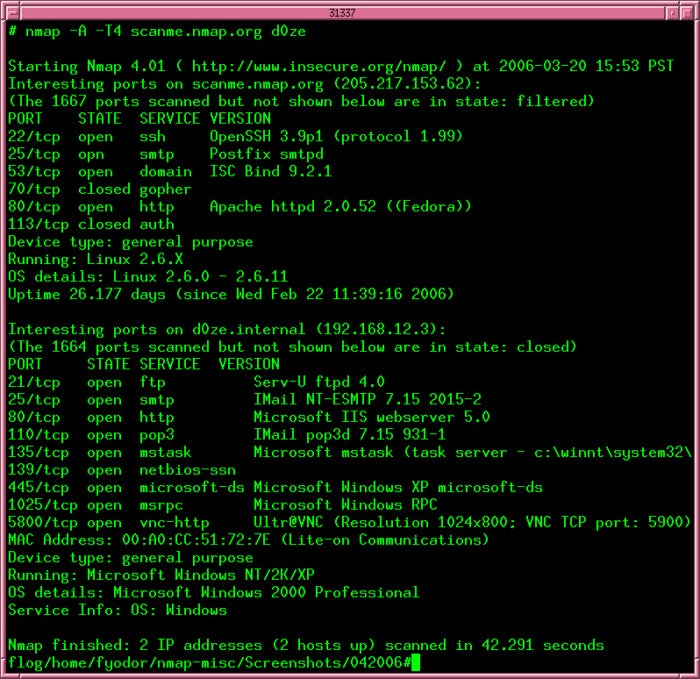
Nmap, short for Network Mapper, is a free, open-source tool for vulnerability scanning and network discovery. Network administrators use Nmap to identify what devices are running on their systems, discovering hosts that are available and the services they offer, finding open ports and detecting security risks.

Nmap can be used to monitor single hosts as well as vast networks that encompass hundreds of thousands of devices and multitudes of subnets.

Though Nmap has evolved over the years and is extremely flexible, at heart it's a port-scan tool, gathering information by sending raw packets to system ports. It listens for responses and determines whether ports are open, closed or filtered in some way by, for example, a firewall. Other terms used for port scanning include port discovery or enumeration.

nmap portscanNmap.org

Since its release in 1997, Nmap has evolved but the basis of its functionality is still port scanning.

Port scanning

The packets that Nmap sends out return with IP addresses and a wealth of other data, allowing you to identify all sorts of network attributes, giving you a profile or map of the network and allowing you to create a hardware and software inventory.

ent protocols use different types of packet structures. Nmap employs transport layer protocols including TCP (Transmission Control Protocol), UDP (User Datagram Protocol), and SCTP (Stream Control Transmission Protocol), as well as supporting protocols like ICMP (Internet Control Message Protocol), used to send error messages.

The various protocols serve different purposes and system ports. For example, the low resource overhead of UDP is suited for real-time streaming video, where you sacrifice some lost packets in return for speed, while non-real time streaming videos in YouTube are buffered and use the slower, albeit more reliable TCP.

Read more ...

Gray Box Testing


What is Gray Box Testing?

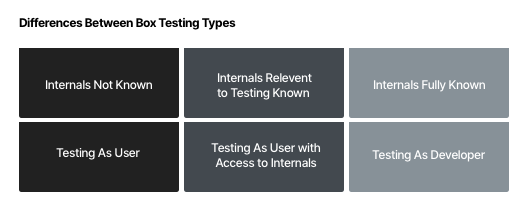
Gray box testing (a.k.a grey box testing) is a method you can use to debug software and evaluate vulnerabilities. In this method, the tester has limited knowledge of the workings of the component being tested. This is in contrast to black box testing, where the tester has no internal knowledge, and white box testing, where the tester has full internal knowledge.

You can implement gray box testing as a form of penetration testing that is unbiased and non-obtrusive. In these tests, the tester typically knows what the internal components of an application are but not how those components interact. This ensures that testing reflects the experiences of potential attackers and users.

Gray box testing is most effective for evaluating web applications, integration testing, distributed environments, business domain testing, and performing security assessments. When performing this testing, you should create clear distinctions between testers and developers to ensure test results aren’t biased by internal knowledge.

The Gray Box Testing Process

In gray box testing, the tester is not required to design test cases. Instead, test cases are created based on algorithms that evaluate internal states, program behavior, and application architecture knowledge. The tester then carries out and interprets the results of these tests.

When performing gray box testing, you take the following steps:

  • Identify and select Inputs from white and black box testing methods.
  • Identify probable outputs from these inputs.
  • Identify key paths for the testing phase.
  • Identify sub-functions for deep-level testing.
  • Identify inputs for sub-functions.
  • Identify probable outputs from sub-functions.
  • Execute sub-function test cases.
  • Assess and verify outcomes.
  • Repeat steps 4-8.
  • Repeat steps 7 and 8.

Gray Box, Black Box, and White Box Testing

Gray box testing is a middle ground between white box and black box testing.

White box testing is an approach that involves testing an application based on knowledge of its inner workings, code, and architecture. It can help discover security issues, data flow errors, and bugs in seldomly-used paths.

Black box testing evaluates a product from the user’s perspective, with no knowledge of its inner workings. Therefore it is an end-to-end approach that tests all systems that impact the end-user, including UI/UX, web servers, database, and integrated systems.

Grey box testing combines the benefits of the black box and white box testing. On the one hand, tests are performed from the user’s perspective. On the other hand, testers do use some inside information to focus on the most important issues and identify the weaknesses of the system.

Gray Box Testing

Differences between white box, black box, and gray box testing

Gray Box Testing Techniques

Gray box testing techniques are designed to enable you to perform penetration testing on your applications. These techniques enable you to test for insider threats, such as employees attempting to manipulate applications, and external users, such as attackers attempting to exploit vulnerabilities.

With gray box testing, you can ensure that applications work as expected for authenticated users. You can also verify that malicious users cannot access data or functionality you don’t want them to.

When performing gray box testing, there are several techniques you can choose from. Depending on which testing phase you are in and how the application operates, you may want to combine multiple techniques to ensure all potential issues are identified.

Matrix Testing

Matrix testing is a technique that examines all variables in an application. In this technique, technical and business risks are defined by the developers and a list of all application variables are provided. Each variable is then assessed according to the risks it presents. You can use this technique to identify unused or un-optimized variables.

Regression Testing

Regression testing is a technique that enables you to verify whether application changes or bug fixes have caused errors to appear in existing components. You can use it to ensure that modifications to your application are only improving the product, not relocating faults. When performing regression testing, you need to recreate your tests since inputs, outputs, and dependencies may have changed.

Pattern Testing

Pattern testing is a technique that evaluates past defects to identify patterns that lead to defects. Ideally, these evaluations can highlight which details contributed to defects, how the defects were found, and how effective fixes were. You can then apply this information to identifying and preventing similar defects in new versions of an application or new applications with similar structures.

Orthogonal Array Testing

Orthogonal array testing is a technique you can use when your application has only a few inputs that are too complex or large for extensive testing. This technique enables you to perform test case optimization, where the quality and number of tests performed balance test coverage with effort. This technique is systematic and uses statistics to test pair-based interactions.

Gray Box Testing Pros and Cons

When determining whether or not to use gray box testing, you should consider the following pros and cons. These can help you determine if gray box testing is appropriate for your testing situation and how much value it may provide.

Pros

Pros of gray box testing include:

  • Clear testing goals are established, making it easier for testers and developers
  • Testing accounts for a user perspective, improving the overall quality of products
  • Testers do not need to have a programming expertise
  • Testing methods create more time for developers to fix defects
  • It can provide the benefits of both black and white box testing
  • It can eliminate conflicts between developers and testers
  • It is cheaper than integration testing

Cons

Cons of gray box testing include:

  • It can be difficult to associate defects with root causes in distributed systems
  • Code path traversals are limited due to restricted access to internal application structure
  • It does not allow for full white box testing benefits since not all internals are accessible
  • It cannot be used for algorithm testing
  • Test cases can be difficult to design
Read more ...
Designed By Himanshu