
What is Nmap?
Nmap, short for Network Mapper, is a free, open-source tool for vulnerability scanning and network discovery. Network administrators use Nmap to identify what devices are running on their systems, discovering hosts that are available and the services they offer, finding open ports and detecting security risks.
Nmap can be used to monitor single hosts as well as vast networks that encompass hundreds of thousands of devices and multitudes of subnets.
Though Nmap has evolved over the years and is extremely flexible, at heart it's a port-scan tool, gathering information by sending raw packets to system ports. It listens for responses and determines whether ports are open, closed or filtered in some way by, for example, a firewall. Other terms used for port scanning include port discovery or enumeration.
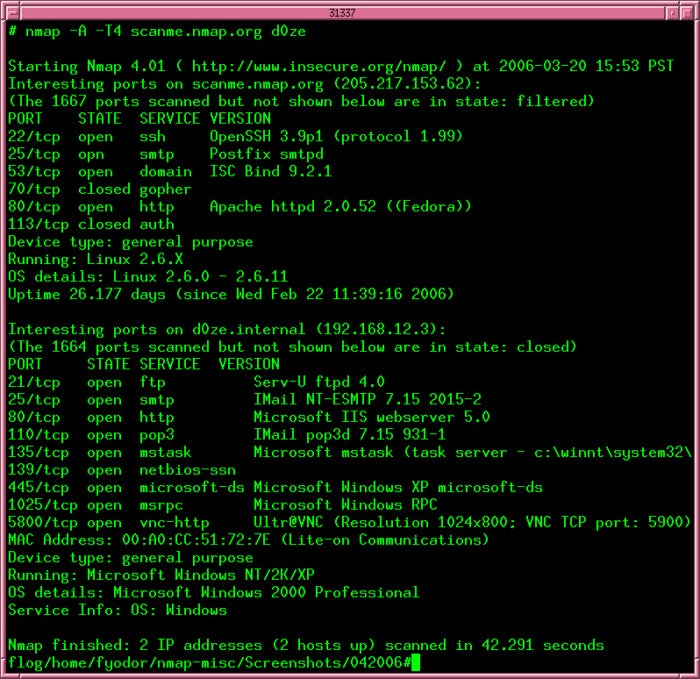 Nmap.org
Port scanning
The packets that Nmap sends out return with IP addresses and a wealth of other data, allowing you to identify all sorts of network attributes, giving you a profile or map of the network and allowing you to create a hardware and software inventory.
ent protocols use different types of packet structures. Nmap employs transport layer protocols including TCP (Transmission Control Protocol), UDP (User Datagram Protocol), and SCTP (Stream Control Transmission Protocol), as well as supporting protocols like ICMP (Internet Control Message Protocol), used to send error messages.
The various protocols serve different purposes and system ports. For example, the low resource overhead of UDP is suited for real-time streaming video, where you sacrifice some lost packets in return for speed, while non-real time streaming videos in YouTube are buffered and use the slower, albeit more reliable TCP.

No comments :
Post a Comment